
Location and contacts
Region: Buxoro viloyati
Address: Mirdo‘stim ko‘chasi
Geographic latitude: 39.77433
Geographic longitude: 64.40567
Map:Yandex Maps
Phone: +998914108300
Website: -
Historical and Cultural Places
Buxoro viloyati | Mirdo‘stim ko‘chasi
The Modarikhan Madrasa is an architectural monument in Bukhara, located opposite the Abdullah Khan Madrasa. Built in 1566–1567, the two madrasas together form the famous Kosh Madrasa (“Twin Madrasa”) complex. Today, the monument is included in the National Register of Immovable Objects of Material and Cultural Heritage of Uzbekistan.
The Modarikhan Madrasa is an architectural monument in Bukhara, located opposite the Abdullah Khan Madrasa. Built in 1566–1567, the two madrasas together form the famous Kosh Madrasa (“Twin Madrasa”) complex. Today, the monument is included in the National Register of Immovable Objects of Material and Cultural Heritage of Uzbekistan.
The Modarikhan Madrasa was built in honor of the mother of Abdullah Khan II. Construction took place between 1566 and 1567. Hafiz Tanish Bukhari, a court historian of the period, recorded in his work Abdullanama that the people of Bukhara actively participated in the construction of the madrasa.
The main portal faces west and is distinguished by its decorative corner towers known as guldasta. Most of the original decorative elements have been preserved on the main façade. The ornamentation is dominated by white, light blue, dark blue, dark brown, and black colors.
At the upper part of the portal, the word “Allah” is written in geometric Kufic script. Above the entrance gate there was a ceramic inscription in white letters mentioning Abdullah Khan II as the patron of the construction, Nuriddin Qazi Muhammad, the chief judge of Bukhara, as the author of the inscription text, and the date of completion. During restoration work carried out in 1998–1999, this inscription was replaced with a new one.
The portal also contains verses 1–5 of Surah Al-Alaq from the Holy Qur’an, written in white letters on a blue background in Thuluth script. Above them, the phrase “The Kingdom belongs to Allah” is repeatedly written in yellow Kufic script.
On both sides of the entrance, the name “Muhammad” appears in the Kufic Bannai style. Many inscriptions were damaged by earthquakes over the centuries. The inscription above the entrance remains the only surviving original epigraphic inscription of the madrasa. It is written in white letters on a dark blue background and was partially restored in 1998 using archival photographs.
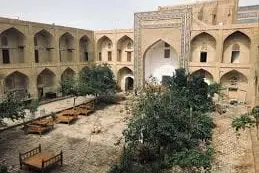
The madrasa follows a four-iwan layout and measures 67 × 45 meters. It consists of two stories. The main façade is dominated by a monumental portal flanked by two-story sections with arched galleries divided into three parts. Their façades are decorated with geometric ceramic tilework.
The corners of the building are marked by guldasta towers ornamented with glazed bricks. Each student cell contains a doorway and a decorative plaster lattice above it. The remaining exterior walls are relatively plain.
At the center lies a rectangular courtyard surrounded by cells with iwans. The central hall, classroom, mosque, and corner rooms are covered with domes. The pendentives are decorated with intricate lattice-like plaster carvings.
The wall construction is characteristic of 16th-century Bukhara architecture: the outer layers are built of baked bricks, while the inner core is filled with broken brick fragments. The madrasa underwent major restoration work in 1997–1998.
Region: Buxoro viloyati
Address: Mirdo‘stim ko‘chasi
Geographic latitude: 39.77433
Geographic longitude: 64.40567
Map:Yandex Maps
Phone: +998914108300
Website: -
Price:-
Services:
Be the first to leave a review.
Quick Publish is 1-2 minutes. Advanced mode includes full details and 3-language content.
Rolangizda e'lon joylashtirish ruxsati yo'q.
