
Location and contacts
Region: Buxoro viloyati
Address: Xodja Nurobod ko‘chasi
Geographic latitude: 39.77607
Geographic longitude: 64.41467
Map:Yandex Maps
Phone: +998914108300
Website: -
Historical and Cultural Places
Buxoro viloyati | Xodja Nurobod ko‘chasi
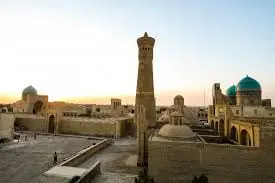
The Kalyan Minaret, also known as the Arslan Khan Minaret, is one of the most remarkable architectural monuments of Bukhara and forms part of the Po-i-Kalyan architectural complex. Standing 47.5 meters high, it is the tallest structure in the old city of Bukhara. The minaret was built in 1127 by order of the Karakhanid ruler Arslan Khan according to the design of the architect Usta Baqo.
The Kalyan Minaret, also known as the Arslan Khan Minaret, is one of the most remarkable architectural monuments of Bukhara and forms part of the Po-i-Kalyan architectural complex. Standing 47.5 meters high, it is the tallest structure in the old city of Bukhara. The minaret was built in 1127 by order of the Karakhanid ruler Arslan Khan according to the design of the architect Usta Baqo. Today, it is included in the National Register of Immovable Objects of Material and Cultural Heritage of Uzbekistan.
An earlier minaret once stood on the same site but eventually collapsed. Arslan Khan then ordered the construction of a stronger and more durable replacement.
The primary function of the minaret was to call Muslims to prayer through the adhan. Traditionally, minarets were built beside mosques or in front of congregational mosques. In addition to its religious role, the minaret also served as an observation tower during periods of unrest and warfare. For centuries, the Kalyan Minaret was used to monitor the surrounding area and to summon worshippers to Friday and holiday prayers at the Kalyan Mosque.
Legends claim that during the period of the Emirate of Bukhara, criminals were thrown from the top of the minaret as a form of execution. However, no historical documents or reliable evidence support these stories, and they are generally regarded as folklore.
Many legends surround the construction of the monument. According to one popular story, the builder created the foundation using a mixture of camel’s milk and alabaster. He then disappeared for two years to allow the foundation to harden before returning to complete the brick structure.
The minaret was built in 1127 by the Karakhanid ruler Arslan Khan Muhammad based on the design of the engineer and architect Baqo. Its foundation was constructed from stone and a special durable mortar.
In 1920, during the assault on Bukhara by the Red Army under Mikhail Frunze, the minaret suffered significant damage, traces of which remain visible today. It was also affected by the Gazli earthquake of 1976.
During the 1950s, local historian S. N. Yurenov investigated the foundation of the minaret but was unable to reach the deepest archaeological layers because of groundwater.
Orientalist scholar Ghulom Karimiy demonstrated in his book The Arslan Khan Minaret that the monument’s historically accurate name is “Arslan Khan Minaret” rather than “Kalyan Minaret.”
The minaret forms part of the Po-i-Kalyan complex together with the Kalyan Mosque, the Miri Arab Madrasa, and the Amir Alim Khan Madrasa. According to historian Qahramon Rajabov, it is one of the tallest and most impressive minarets in the Turkestan region.
The foundation of the minaret extends approximately 10 meters below ground level. The structure rises to a height of 47.5 meters. It has a polygonal base, a cylindrical shaft, and a domed lantern gallery at the top.
The tower gradually narrows as it rises and culminates in decorative muqarnas. Sixteen arched openings in the upper gallery provide panoramic views of the surrounding city. Access to the top is provided by a spiral staircase consisting of 105 steps inside the tower. A special bridge connects the minaret to the Kalyan Mosque.
Both the structural core and decorative elements are built from square baked bricks measuring 27 × 27 × 4–5 centimeters. The bricks were carefully shaped and arranged to create intricate ornamental patterns.
The exterior is decorated with numerous ornamental bands featuring geometric designs and brick friezes. Kufic inscriptions with historical and religious content are incorporated into the decoration. Beneath the muqarnas were once blue glazed decorative bands featuring various geometric motifs, although many of them have not survived.
The harmony of proportions, geometric precision, monumental appearance, and artistic beauty make the Kalyan Minaret one of the masterpieces of medieval architecture. For more than 900 years, it has remained a symbol of strength and elegance. More than twenty decorative ornamental bands encircle the structure.
In 1924, the shaft and muqarnas were restored. In 1960, master builder Ochil Bobomurodov excavated and restored the underground foundation. Extensive restoration work was carried out in 1997 as part of the celebrations marking the 2,500th anniversary of Bukhara. Today, the Kalyan Minaret remains one of the most iconic and treasured monuments of the city.
Region: Buxoro viloyati
Address: Xodja Nurobod ko‘chasi
Geographic latitude: 39.77607
Geographic longitude: 64.41467
Map:Yandex Maps
Phone: +998914108300
Website: -
Price:-
Services:
Be the first to leave a review.
Quick Publish is 1-2 minutes. Advanced mode includes full details and 3-language content.
Rolangizda e'lon joylashtirish ruxsati yo'q.
